


10th Anniversary of the Artist’s Death
Honi Hameagel was a true Dada artist. As a museum dedicated to this movement, we collaborated with him over three decades to produce numerous projects within our walls and beyond them across the country. These included: “Wake Up Little Suzie” (1993); “The Baptism/Cold Shower” (1996); “Great Scrolls of Fire” (2000); “40 Years to Victory” (2007); “Street Language” (2010); “The End” (2012); and his final exhibition,“Victim of impeded Development” (2016), in which he placed his own future headstone and grave stones within the exhibition space, beneath which he was buried just three months after the show closed. True to the spirit of Dada, all of these projects displaced fragments of life from one environment to another, imbuing them with new meaning and bringing the margins of life to the forefront of the artistic stage.
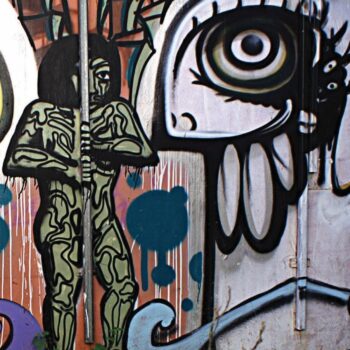
This exhibition focuses on “Street Language”, a series of photographs displayed in 2010 on billboards nationwide, while the museum was undergoing renovations. Among the tens of thousands of photographs created by Honi, a gifted photographer, this series stands out. It features graffiti art from the Tel Aviv metropolis captured over nearly thirty years: paintings created by artists, some anonymous, on walls, garbage dumpsters, public payphones, and more. The concept of displacing these images to other locations across the country was an attempt to transmit the unique urban pulse and rhythm of Tel Aviv to other regions.
For Honi, wall paintings were an ephemeral component of the cityscape. He documented them fully aware that they might vanish by the next day. He typically focused on the artworks themselves, though he occasionally included the surrounding environment and the visible ravages of time within the frame. He made no attempt to embellish reality, nor did he intervene in the appearance of his subject matter. Reality, as it was, held intrinsic beauty for him, and he sought to convey his affection for his subjects to the viewer.
The fact that the photographed subject was created by another artist raises the question of authorship: Is the true author the creator of the original work, or the photographer who appropriated it? This debate forms an integral part of postmodern discourse. In Honi’s view, the moment a work entered the public sphere, it became devoid of copyright. The act of reproduction, which served as a foundational element of his artistic practice, reached its pinnacle in this series, where he displaced not only fragments of life, but also artworks that often bore their creator’s signature. Honi’s photographs remain tethered to the original pieces, yet through the act of photography, he established the ethical justification for converting them into creations of his own.
Honi was a multidisciplinary artist whose work was deeply intertwined with theater and cinema for decades. The photographer’s eye captured the precise composition and lighting, the filmmaker within him sought the most compelling narrative, and the performer aimed to present the drama. Photographing graffiti and reinstalling it in the public sphere on commercial billboards, bearing both his name and that of the museum, allowed him to converge all these elements into a single, distilled moment.
Raya Zommer-Tal
Exhibition Curator