


In the Depths of the Forest
Sam Halaby creates artistic projects in Israel and abroad, presenting environments, installations, and large-scale paintings that incorporate readymade objects.
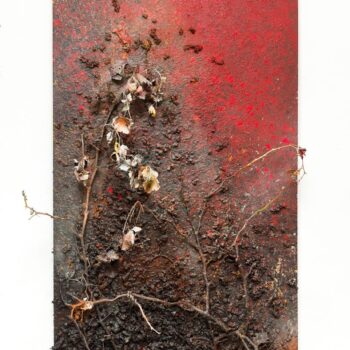
In the paintings in this exhibition, Halaby incorporates branches of varying sizes that extend beyond the pictorial surface, destabilizing its boundaries. He dries the branches and coats them in a sealant, in a process akin to “embalming” that arrests their further decay and transforms them into material in the hands of the artist. The olive and pine branches, together with grapevine tendrils, carry the memory of the trees from which they were severed, symbolizing withering and finality, while simultaneously embodying the possibility of continuity and rebirth within the artwork.
The dialogue that emerges between the intense color, sprayed onto the pictorial surface or applied in broad, sweeping brushstrokes and the tangle of branches yields expressive, poetic works that move within the tension between outside and inside, the natural and the cultivated.
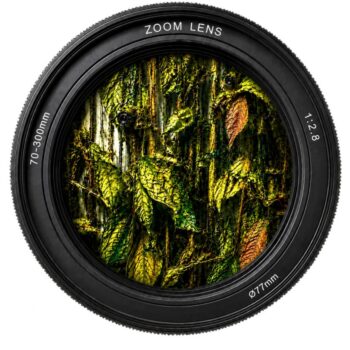
At the center of the exhibition stands an installation simulating a legendary forest, dark and mysterious, composed of a dense thicket of dried, painted olive branches, into which the viewer is invited to enter and forge a path. The movement of visitors activates sensors that illuminate dozens of small, colored lights concealed within the thicket; the forest responds to motion, awakening for a moment before receding once again into darkness. For Halaby, situating this tangled forest within the exhibition’s central space constitutes a Dadaist gesture that disrupts order.
The concept of the “forest” is a potent archetype within human culture, constituting a symbolic space that represents primal, untamed nature. In analytical psychology, the forest symbolizes the unconscious, drives, fears, and repressed memories. To walk through the forest is to move inward, toward a place where familiar identity is destabilized and the self must be reconstructed anew.
In literature and folk tales, the forest often serves as the central arena of the narrative. It is a perilous space situated outside the existing social order, and whoever enters risks losing their way. And yet it is precisely this sojourn within it that enables an encounter with the unknown, and an opportunity to undergo new experience.
Across the visual arts, cinema, and theatre, the forest is a site suspended between beauty and terror. In Romantic painting, the forest is a sublime site, an immense force of nature that dwarfs man and evokes within him spiritual awe. The light filtering through the treetops does not dispel the darkness but deepens it, lending it a dimension of mystery and sanctity.
Halaby’s forest is rooted in his own biography in the landscape of his Carmel childhood, and in his struggle to become an artist. Embedded within this symbolic thicket are the pain and frustration that accompanied a childhood passion to create, one that did not always meet with understanding and acceptance within the traditional environment in which he was raised. Halaby’s choice of olive branches as a constitutive element of the installation is deeply significant: the olive tree symbolizes his childhood landscape, his cultural heritage, and the roots from which he grew and to which he remains bound. The forest is not presented as a landscape to be observed from a distance, but as a psychic state one must dare to enter, undergoing a profoundly stirring experience.
Rina Genussov
Exhibition Curator